
Most business agreements can be signed electronically in the US. The documents that still need wet ink are a short list: wills and testamentary trusts, many court documents, family law matters, certain default and cancellation notices, and documents that must be notarized or recorded with a local government office. If a document is on that list, plan for paper. If it is not, e-signing is almost always valid under the E-SIGN Act and UETA.
This guide walks through the categories, explains why each one is carved out, and shows how to keep the paper exceptions from slowing down the rest of your deals. For the broader ink-versus-electronic choice, see wet signature vs electronic signature.
TL;DR
- Federal law says a signature or contract cannot be denied effect solely because it is electronic, but the same framework carves out specific document types.
- Wills, codicils, testamentary trusts, many court and family law documents, and certain utility, insurance, eviction and foreclosure notices are the classic wet-ink categories.
- Deeds, mortgages and other recorded documents often need ink because the recording office decides what it will accept.
- Rules vary by state, so confirm with the court, agency or recorder involved before you send a signing link.
- Sales agreements such as MSAs, SOWs, DPAs, NDAs and Order Forms are usually fine to e-sign. Keep them in one digital workflow and reserve paper for the true exceptions.
Why wet ink still exists
A wet signature is a handwritten mark applied in ink to a physical document. LegalZoom's glossary notes it remains legally required for certain contracts, government filings and court documents.
The default rule points the other way. Under the federal E-SIGN Act, for transactions in or affecting interstate or foreign commerce, a signature, contract or other record may not be denied legal effect just because it is electronic. Most states have adopted the Uniform Electronic Transactions Act (UETA), which follows four basic rules: an electronic record or signature cannot be denied effect for being electronic, a contract cannot be denied effect for using an electronic record, an electronic record satisfies a writing requirement, and an electronic signature satisfies a signature requirement.
So wet ink is the exception, not the rule. The exceptions exist because lawmakers wanted extra formality, extra identity checks or government control over certain records. For a deeper look at how the two laws fit together, see our explainer on the E-SIGN Act and UETA.
The categories that may still need a wet signature
The federal highway administration's review of state e-signature laws lists the document types that may require a written signature. The Federal Register guidance on ESIGN reaches a similar list of excluded categories. Together they cover the following.
| Category | Typical examples | Why it matters |
|---|---|---|
| Estate documents | Wills, codicils, testamentary trusts | Excluded from ESIGN and from many state UETA laws |
| Family and probate matters | Adoption, divorce, related court filings | Governed by domestic relations and probate statutes |
| Court documents | Orders, pleadings, briefs, notices | Courts set their own filing rules |
| Utility notices | Service cancellation or termination notices | Consumer protection carve-out |
| Housing and credit notices | Foreclosure, eviction, repossession, default notices | Consumer protection carve-out |
| Insurance and product safety | Certain benefit cancellation notices, product recall notices | Health and safety carve-out |
| Hazardous materials | Documents accompanying dangerous substances | Safety regulation |
| Notarized documents | Anything requiring a notary under state law | Notary rules and identity verification |
| Property records | Deeds and other documents to be recorded | Recording office acceptance rules |
The American Bar Association makes the same point from the practitioner side: documents outside ESIGN and UETA, including powers of attorney, wills, codicils, trusts, divorce decrees and court orders, may not be binding with an electronic signature.
Commercial code items
Some state laws also exclude items governed by the Uniform Commercial Code. The FHWA review found that seven of the eight state laws it examined specifically exclude electronic signatures on items such as funds transfers, warehouse receipts, investment securities, secured transactions and negotiable instruments. If your deal includes a negotiable instrument or a secured transaction, check the specific state rule before you route it to a signing link.

Real estate and recorded documents
Real estate is where most people meet wet ink in practice. Even when an electronic signature would be enforceable between the parties, the office that records the document has the final word on format. The ABA notes that wet-ink signatures may still be required for mortgages, deeds of trust and other documents that must be notarized and recorded, and that many local registries will not accept documents for recording without them.
Cleary Gottlieb explains the mechanism. For documents filed or recorded with a governmental authority, wet signatures may be needed because UETA leaves it to the authority to decide whether and when it will use electronic records and signatures.
FindLaw adds a useful nuance: deeds often need wet ink while other sales documents may not, and buyers should get legal advice on the requirement in their state. In a brokerage or construction workflow, that means the purchase agreement, disclosures and addenda can often be signed electronically while the deed goes to the notary and the recorder on paper. Our post on defensible e-signing for construction and real estate covers how teams split those two tracks.

Court filings and government submissions
Court documents are the other big bucket. Cleary Gottlieb notes that for items such as briefs, pleadings and testamentary or family law documents, wet signatures are generally needed because E-SIGN does not apply to them. Courts, however, often run their own e-filing systems with their own signature rules. Treat the local court rules as the authority, not the general e-signature statutes.
Government contracting has its own submission and certificate conventions too. If your team sells to federal buyers, GSA's move from DocuSign to eOffer is a good example of how an agency can change what it accepts. Always check the current instructions from the agency receiving your paperwork.
How state rules change the picture
Federal law sets the floor, and states fill in the rest. The FHWA review found that none of the eight state laws it reviewed were stricter than UETA, and that some states exclude electronic signatures only for wills, codicils and testamentary trusts while others add further exclusions.
FindLaw confirms that most states' UETA laws exempt documents that must carry wet-ink signatures, generally court documents and health and safety matters. In practice, three questions decide the answer:
- What type of document is it? Match it against the categories above.
- Who receives it? A court, county recorder, agency or notary may impose its own format.
- Which state's law governs? Check the state's UETA version and any local rules.
When the answer to any of the three is unclear, ask the receiving office or a licensed attorney in that state. That is a short phone call and it prevents a rejected filing.
Does it have to be black ink?
For most private contracts, no. LegalClarity reports that no federal law mandates a particular ink color for most legal documents, although blue and black are common. Its practical tips: sign inside the designated line or box, avoid correction fluid or tape, and fix an error by crossing it out, writing the correction and having the parties initial and date it.
Recorded documents can be stricter. Missouri law, for example, says signatures on a document presented for recording must be in black or dark ink that reproduces legibly, with the signer's name typed, printed or stamped beneath it. Other states have their own recording standards, so read your county recorder's requirements before signing.
A practical checklist for paper signatures
When a document truly needs ink, a little preparation avoids rework.
- Confirm the requirement first. Check the court, recorder, agency or notary instructions for the exact format.
- Prepare the final version digitally. Finish drafting, review and negotiation online so the paper copy is clean and only needs signing.
- Print single-sided on standard paper unless the receiving office says otherwise.
- Mark every signature and initial spot with a flag or a clearly labeled line.
- Use dark ink and keep to the signature line.
- Book the notary early if one is needed, and bring the identification the notary requires.
- Scan the signed original and store it with the digital record so your team has one source of truth.
- Track the courier or hand-delivery for anything that must arrive by a deadline.
Keep the exceptions from slowing down the rest
The common mistake is treating one paper exception as a reason to keep everything on paper. Founders, account executives and general counsel rarely sign deeds or wills as part of daily work. They sign MSAs, DPAs, SOWs, LOIs, Order Forms, NDAs and pilot agreements, and those are the agreements that stall deals when they bounce between email threads, PDFs and printers.
A sound approach is to sort documents at intake:
- Standard commercial agreements: draft, review, negotiate and e-sign in one workflow.
- Hybrid transactions: e-sign the commercial paperwork and route only the recordable or notarized piece to paper.
- Statutory exceptions: handle on paper from the start, and keep a digital copy and a log of what was signed and when.
If you want a refresher on what a valid electronic signature involves, read what electronic signatures are. For a side-by-side look at the trade-offs, see our wet signature vs electronic signature guide. Teams collecting signatures at scale can use the six-step digital signature checklist. Not every notice needs a signature at all: for policy updates across a large user base, clickwrap can be the better fit.
Our perspective
The wet-ink list is short, and it is stable. Our view is that teams get into trouble in two ways: by e-signing something that belongs on paper, and by printing everything because a few documents do.
We built Formable so the commercial agreements that drive revenue stay in a single workflow: drafting with templates and generative AI, AI review against your playbook, redlining and negotiation, e-signing and tracking. Each step leaves a record, including audit trails, so you can show who signed what and when.
For the rare document that needs ink, the work upstream still counts. Draft it, review it and agree the terms digitally, then send only the final version to paper. That keeps the exception small and the deal moving.
Our security and legal-validity approach is described on our security page. If you are unsure whether a particular agreement qualifies for e-signing, reach out and we will walk through your use case.
Alex
Move your everyday agreements off paper
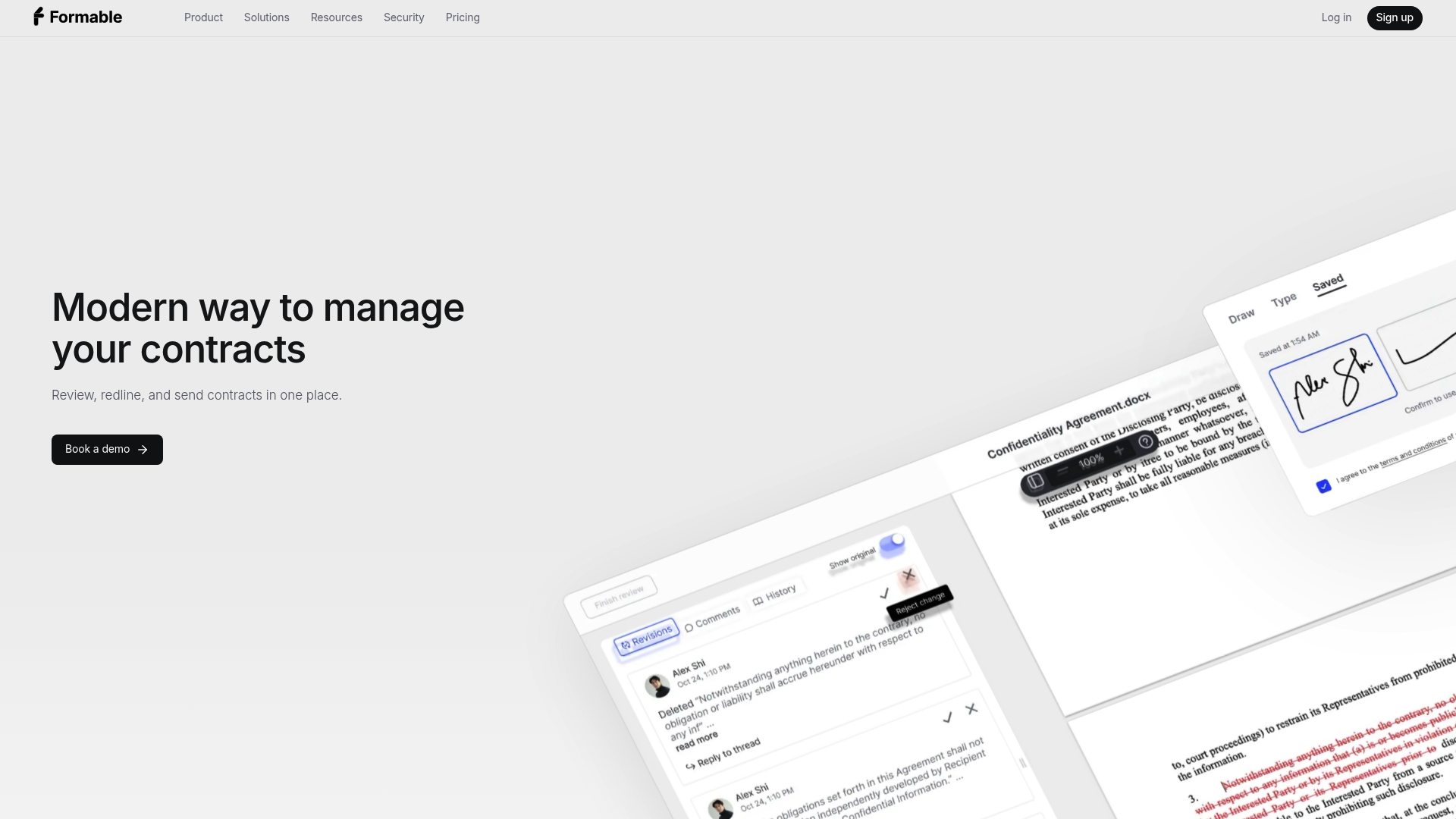
Formable is a contract management platform for startups and go-to-market teams. You can generate agreements with the contract creator, catch risks and missing clauses with AI contract review, and send agreements for browser-native negotiation before signing with E-Signing.
The Pro plan is listed at $19.99 per month on our pricing page. Developers who want signing inside their own product can look at the embedded e-signing API and the API pricing.
FAQ
What is a wet signature on a document?
It is a handwritten signature made in ink on a physical document. It differs from an electronic signature, which is captured and recorded digitally. For most commercial agreements both are valid, but certain documents still require the paper version.
Are e-signatures legally enforceable in the US?
Generally yes. Under 15 U.S.C. § 7001, a signature or contract cannot be denied legal effect solely because it is electronic, for transactions in or affecting interstate or foreign commerce. The exceptions are specific categories such as wills, many court documents and certain notices.
Do legal documents have to be signed in black ink?
Not usually. LegalClarity notes there is no federal ink-color mandate for most legal documents, though blue and black are common. Documents for recording can have stricter rules, such as Missouri's black or dark ink requirement.
Can I e-sign a real estate purchase agreement?
Often yes, but the deed is different. FindLaw notes that deeds often need wet ink while other sales documents may not. Confirm the requirement with your state's rules, the recorder and an attorney.
Which of my sales contracts could still need wet ink?
MSAs, SOWs, DPAs, NDAs and Order Forms are typically ordinary commercial agreements. Check only if a deal includes an excluded item, such as a notarized document, a recorded property document or a negotiable instrument, and confirm with counsel.
Sources
- 15 U.S.C. § 7001: general rule of validity
- State laws addressing validity of electronic signature (FHWA)
- Federal Register guidance on ESIGN, October 2002
- Electronic signatures and legal opinions (American Bar Association)
- Electronic execution of agreements in the remote working environment (Cleary Gottlieb)
- Contracts, electronic signatures and digital signatures (FindLaw)
- What is a wet signature? (LegalZoom)
- How to create a wet signature (LegalClarity)
- Missouri RSMo 59.310
- GSA's DocuSign transition to eOffer